
The Accountant’s Dragon
Never judge a reader by their writing.
There was once a village where everyone wore the clothes of the sentences they wrote.
The accountant wore a neatly pressed suit with twelve pockets, all correctly numbered. The poet wore a scarf long enough to suggest unresolved feelings. The technical writer had labelled his shoes LEFT and RIGHT.
The village mayor considered this an excellent arrangement.
“At last,” he declared, “we know who everyone is.”
Then the librarian opened the returns box.
And out fell a dragon.


A small irregularity in the accounts
The dragon belonged to the accountant.
This caused considerable concern. His last email had read:
“Please find attached the revised figures.”
No mountains. No prophecies. Not even a suspicious egg.
Yet every evening, after balancing the accounts, he climbed into a world where kingdoms burned, ancient creatures spoke and somebody called Tharagon the Unreasonably Tall misplaced a magical sword.
“Surely you prefer books about finance?” asked the mayor.
“I spend all day making numbers behave,” said the accountant. “At night, I enjoy a dragon with no respect for the budget.”
The dragon sneezed.
A small municipal expense caught fire.


The poet had questions
Naturally, everyone turned to the poet. She would restore some literary order.
Her writing contained moonlight, trembling leaves and the occasional silence that required its own paragraph.
Her library bag contained three murder mysteries.
“Where is the poetry?” asked the mayor.
“At home. Being written.”
“And these?”
“People being murdered in attractive villages.”
“But your work is so gentle.”
“Yes,” she said. “And I would like to know who put arsenic in the marmalade.”
Apparently, a person could spend the morning listening to the soul of a river and the evening examining a fictional gardener’s alibi.
The mayor made a note.
He underlined it twice.
Meanwhile, in the engine room
The technical writer was next.
He had recently produced a forty-page guide explaining how to replace a filter. Every instruction was clear. Every warning was precise. Nobody had accidentally removed the boiler.
A useful man.
He was reading a romance.
“There appears to be no diagram,” the mayor observed.
“I’m managing.”
“And no numbered steps?”
“They kissed in chapter seven. I found it without assistance.”
The mayor began to feel that the village classification system had certain weaknesses.
Across the room, a woman who wrote cheerful cake recipes was reading about the collapse of an empire.
“Research?” he asked hopefully.
“Pleasure.”
“But your blog is about sponge cake.”
“Yes. This emperor could have used a slice.”
The wardrobe behind the words
We do this, don’t we?
Someone writes a practical checklist, and we quietly furnish their entire inner life with filing cabinets.
Someone writes poetry, and we imagine they survive on candlelight and meaningful weather.
Someone leaves a short comment, and we decide they probably prefer short everything.
A few sentences, and we have already moved in, chosen the curtains and labelled the cupboards.
Meanwhile, the actual person is halfway through a six-hundred-page novel about a lighthouse keeper who may be a ghost.
People have more rooms than their writing shows.
Some rooms are public. Some have a comfortable chair and a locked door. One may contain a pirate.
He pays no rent.


What we make, what we reach for
Writing and reading can answer different appetites.
The person who spends all day producing careful explanations may enjoy a book that refuses to explain itself.
The writer who builds elaborate worlds may reach for a plain account of someone growing potatoes.
After inventing three royal dynasties and a language with fourteen words for betrayal, a potato can be wonderfully reassuring.
Sometimes we read familiar voices because they feel like company. Sometimes we read something wildly different because our own voice has been talking all day.
Even poets occasionally want the moon to stop symbolising things and help solve the murder.
And sometimes there is no grand reason.
The cover looked interesting.
A friend recommended it.
There was a dragon.
These remain perfectly respectable literary credentials.



A little trouble for the labels
Eventually, the mayor asked the librarian to help him revise the village register.
He had prepared new categories.
“Perhaps,” he said, “we could record what people write, what they read, and what that tells us about—”
The librarian handed him a book.
“Try this.”
“What is it?”
“A story.”
“What sort?”
“You’ll see.”
He looked uncertain. He usually read policy documents, historical speeches and books with Leadership somewhere on the cover.
This one had a rabbit wearing a crown.
“That seems rather unlikely,” he said.
“So was your filing system.”
He borrowed it.
By Thursday, he had missed two committee meetings and become deeply concerned about the rabbit’s succession rights.
Please return your assumptions by Friday
The librarian kept her own system.
Books went on shelves.
People were allowed to wander.
The accountant continued borrowing dragons. The poet caught several murderers. The technical writer fell in love with a second romance, although he did think the misunderstanding in chapter twelve could have been resolved with a clearer subject line.
And the mayor?
He stopped asking people whether a book was “their sort of thing.”
He had reached the part where the rabbit disappeared.
There were constitutional implications.
So yes, people may write in one style and read in another.
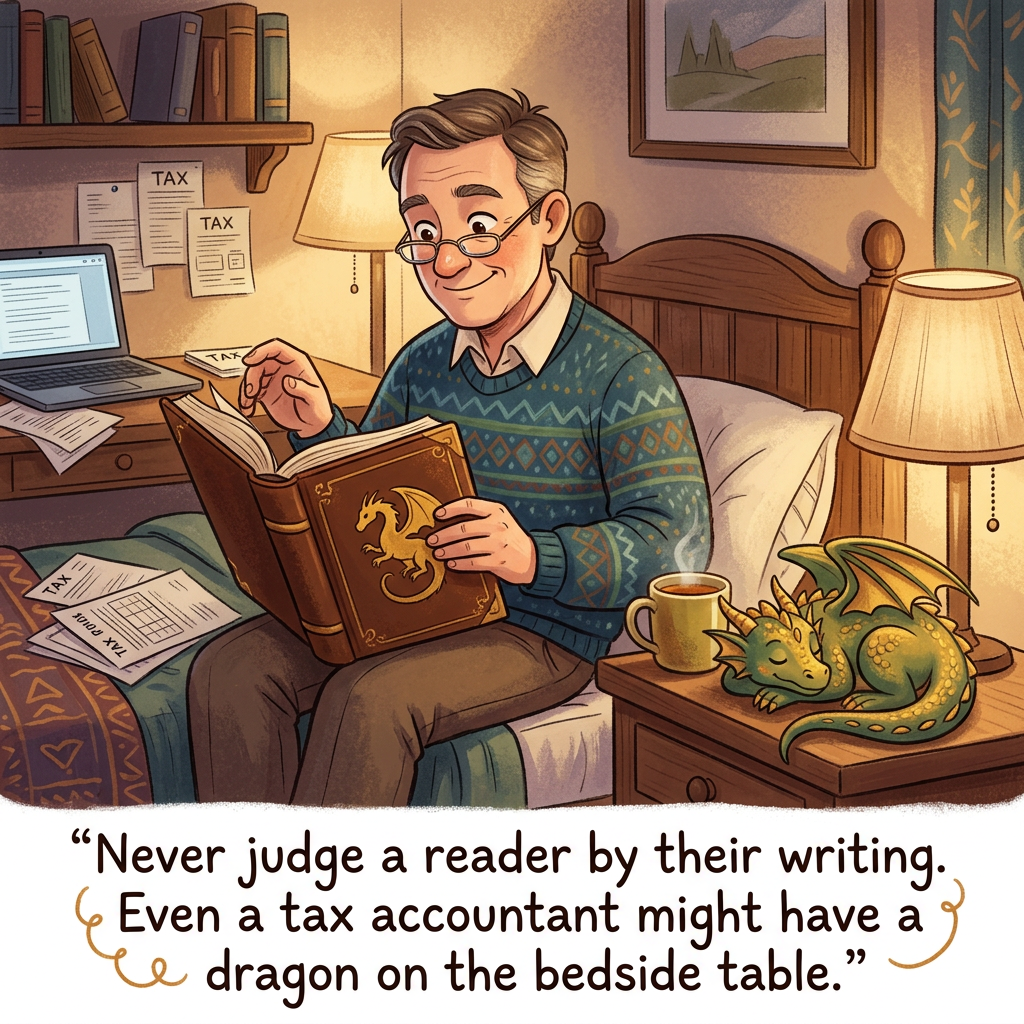
Never judge a reader by their writing. Even a tax accountant might have a dragon on the bedside table.
And if you visit, do mind the curtains.
The dragon has reached a difficult chapter.
Thank you for reading and sharing! 😀🎉
Text and image with help of openAI and MIB

