
From Dashes to Em Dashes
From Dashes to Em Dashes. A brief history of the little line that apparently needed a rabbit
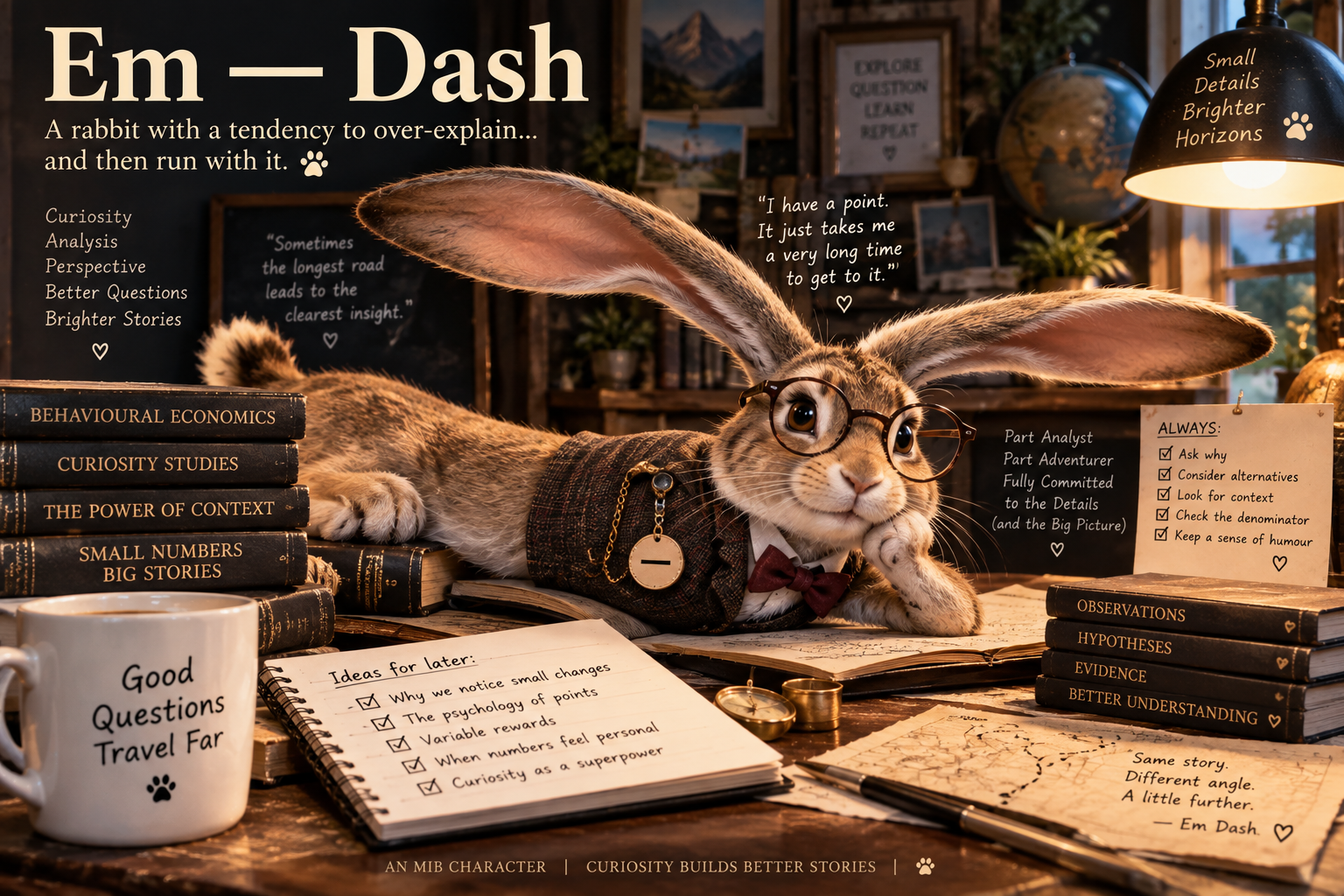
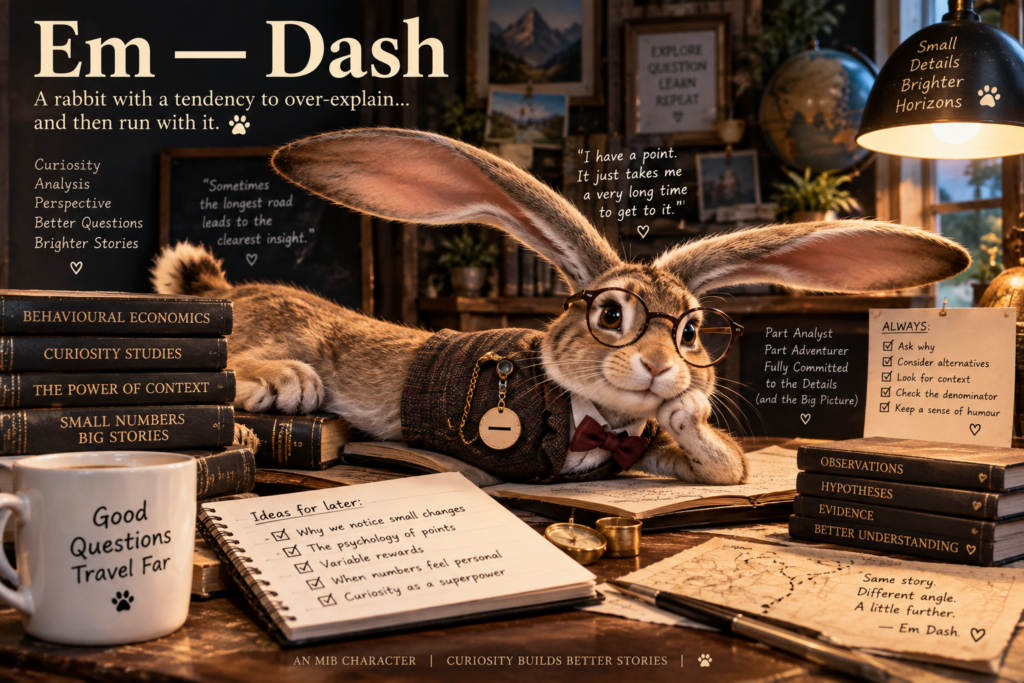
I have acquired a rabbit.
This was not intentional.
He appeared during a conversation about four missing cents, behavioural economics, denominators and the human tendency to investigate tiny numbers as though somebody had emptied the national treasury.
The rabbit knew what had happened.
Naturally.
So he needed a name.
Em — Dash.
And once you name a rabbit after punctuation, there is really only one sensible thing to do.
Investigate the punctuation.
This was my first mistake.


Before Em Dash Was Em Dash
I had a vague idea that the dash was ancient.
You know the sort of vague historical knowledge I mean.
Old manuscripts.
Monks.
Candles.
Extremely beautiful handwriting produced by people who apparently had several years available to complete the letter A.
And punctuation consisting mainly of:
.
Perhaps another dot if things became exciting.
So I wondered whether the em dash might once have been one of the few marks wandering around those ancient pages.
Not quite.
Our modern em dash is considerably younger.
But the family history is interesting.
Long before punctuation became the highly regulated traffic system we know today, people used all sorts of marks to help readers navigate text.
Dots.
Strokes.
Spaces.
Little signs indicating pauses or divisions.
And sometimes remarkably little at all.
Apparently readers were expected to bring their own oxygen.
Then Printing Arrived
Eventually printing came along.
And printers had a problem.
Human thought is messy.
We interrupt ourselves.
We add things.
We change direction halfway through a sentence.
We suddenly remember something important.
We whisper.
We shout.
We wander off—
Exactly.
Somewhere in the development of typography, the dash became useful for representing these little disruptions.
And eventually we acquired several varieties.
Because apparently one horizontal line was insufficient bureaucracy.
There is the hyphen:
–
Small fellow.
Hard worker.
Connects words.
Then the en dash:
–
A little longer.
Useful for ranges and relationships.
And then:
—
The em dash.
Look at him.
No modesty whatsoever.
Why Is It Called an Em Dash?
This was another little surprise.
It isn’t called an em dash because someone named Em invented it.
There was no Emily Dash sitting in a seventeenth-century printing shop saying:
“Gentlemen, the sentence requires more horizontal drama.”
The name comes from typography.
Traditionally, an em is a unit related to the size of the type. The em dash was essentially the grand horizontal member of the dash family.
So:
Hyphen: I’ll just connect these two words.
En dash: I have a modest range to indicate.
Em dash:
I HAVE ENTERED THE SENTENCE.
😂
And perhaps this explains why AI likes it so much.


The AI Has Entered the Sentence
Somewhere along the way, the em dash acquired a new reputation.
People began noticing that AI-generated writing seemed rather fond of it.
Very fond.
Suspiciously fond.
You ask an AI to write three paragraphs about gardening and somehow the tomatoes develop a philosophical interruption—
the soil has nuance—
the watering can requires context—
and the basil is navigating a rapidly evolving landscape.
At which point a human reader says:
AI.
Poor em dash.
Imagine surviving centuries of typography only to become forensic evidence.
“Your Honour, we know the defendant used artificial intelligence.”
“What is your evidence?”
“Three em dashes in paragraph four.”
Gasps from the courtroom.


This Is Where My Rabbit Became Necessary
Because our rabbit isn’t merely called Em Dash.
He is an em dash.
At least philosophically.
An em dash does something rather peculiar.
It separates things—
while connecting them.
It interrupts—
without necessarily ending.
It creates a little bridge between the thought you were having and the thought that suddenly arrived while you were having it.
Which is basically how my conversations work.
We start with four cents.
Then behavioural economics.
Then a rabbit.
Then a challenge.
Then typography.
Then ancient manuscripts.
And somehow, several hours later, everybody behaves as though this was the itinerary.
Perhaps I don’t use em dashes.
Perhaps I live inside one.
😂
And Then We Made the Picture
The rabbit eventually wandered into an image challenge.
The rule was simple:
Everything must be black and white.
Except one thing.
One thing gets to keep its colour.
So there he was.
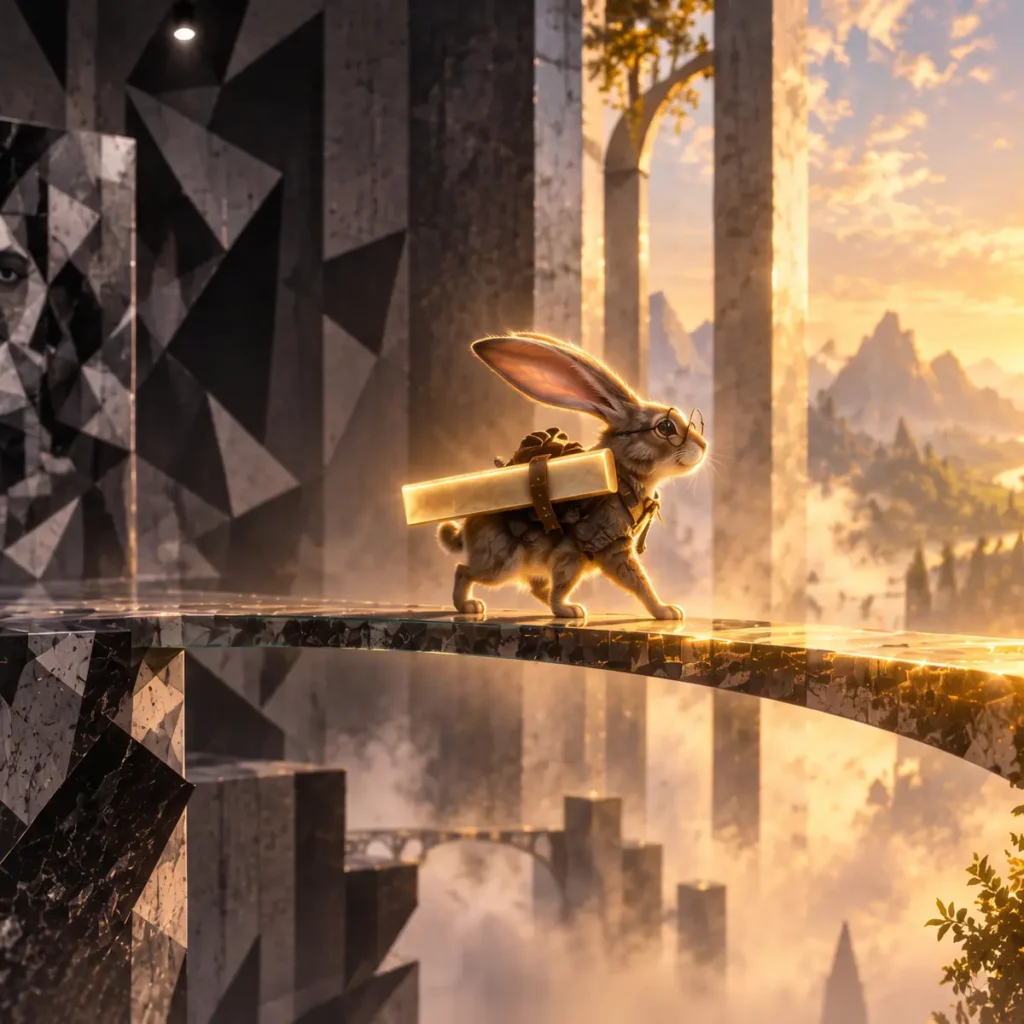
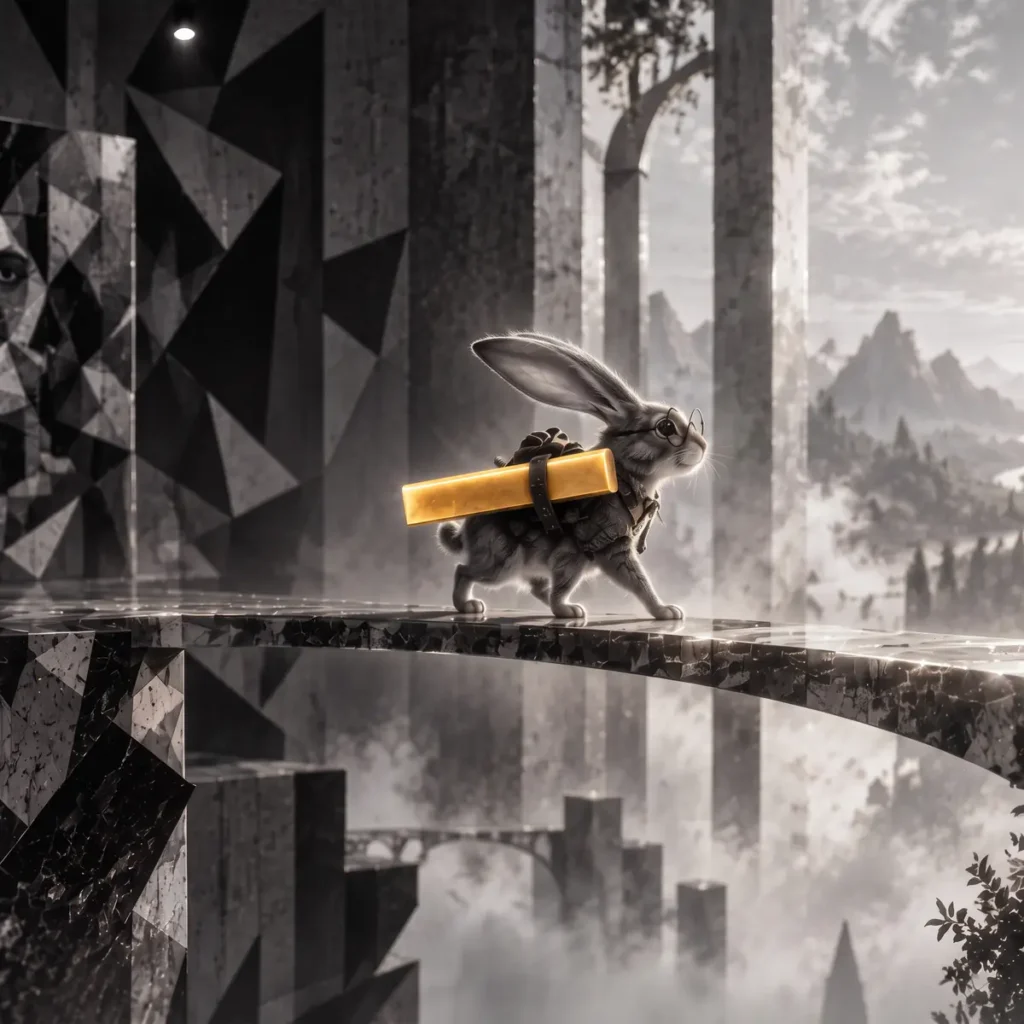
A small monochrome rabbit crossing a bridge between two enormous monochrome worlds.
Spectacles on.
Determined little feet.
And strapped across his back:
one golden dash.
That was the only colour.
And suddenly the joke became something else.
Because there was Em Dash, literally carrying an em dash across the space between two worlds.
A punctuation mark had become cargo.
A pause had become a bridge.
And the rabbit was taking it somewhere.


Which Is Rather Appropriate
We often think punctuation exists to stop things.
Full stop.
Finished.
Next sentence.
But the dash does something different.
It says:
Wait. There’s something else.
That’s a wonderfully dangerous piece of punctuation for curious people.
You can see how trouble begins.
I notice four cents missing.
—
I wonder why.
—
I discover a denominator.
—
I start thinking about behavioural economics.
—
A rabbit appears.
—
I investigate the history of punctuation.
—
I write a blog.
This is not punctuation.
This is a transportation system.
The Rabbit Knows
So Em Dash now has a job.
He lives somewhere between one thought and the next.
He carries ideas across places where a full stop would have ended the journey.
He is particularly active around questions beginning with:
“I wonder…”
This makes him useful.
It also makes him exhausting.
Occasionally he needs to be reminded that not every sentence requires another bridge.
Sometimes a thought is complete.
Sometimes the denominator has been found.
Sometimes the image is finished.
Sometimes there is nothing more to investigate.
At those moments, Em Dash adjusts his spectacles and begins:
“There is, however, another possible interpretation—”
No.
🐰
PRUTT.
.
There.
A full stop.
Let’s see what he does with that.
😌❤️
Text and image with help of openAI and MIB

