
The Poems That Return
The Poems That Return. A poem and an essay
The Poems That Return
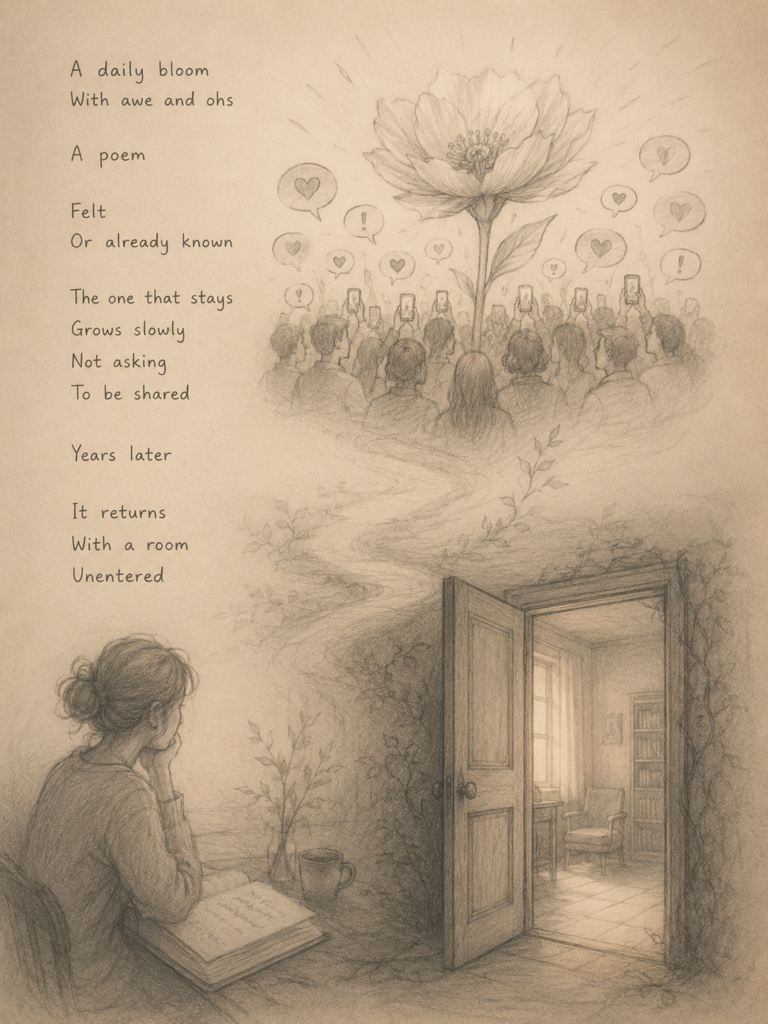
A daily bloom
With awe and ohs
A poem
Felt
Or already known
The one that stays
Grows slowly
Not asking
To be shared
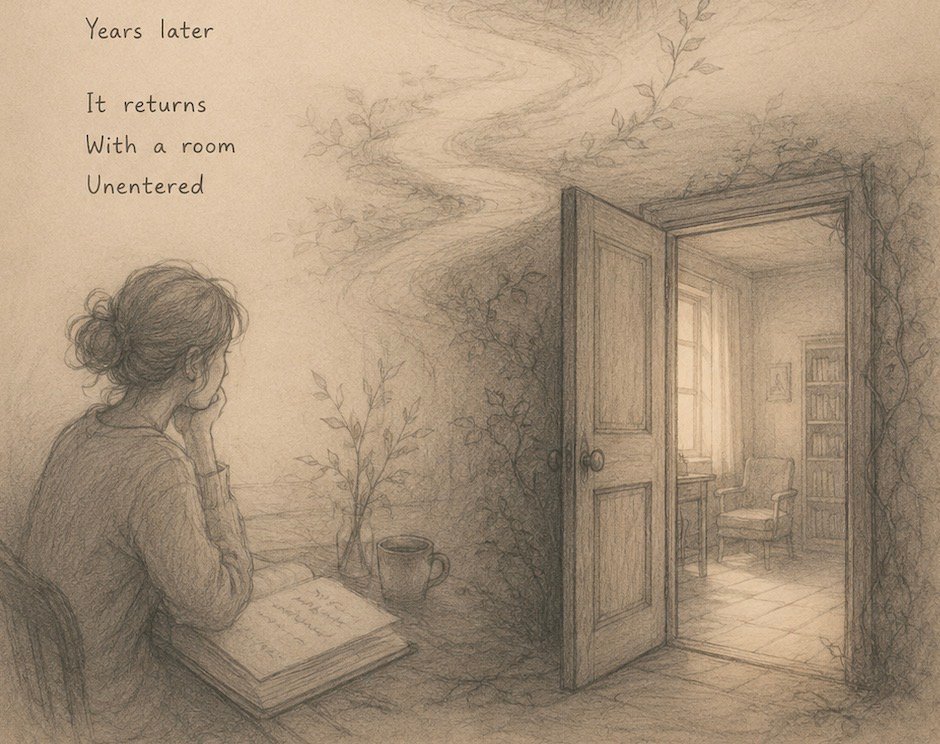
Years later
It returns
With a room
Unentered
©️ Mlaure
an Essay
I thought I was writing about poetry.
Looking back, I think I was writing about attention.
It started with a simple observation. Online, certain poems seem to bloom instantly. They gather likes, shares, comments, screenshots, admiration. People react. They relate. They pass them on.
There is nothing wrong with that.
In fact, there is something beautiful about it.
A few words can travel across continents and find someone at exactly the right moment. A poem can become a bridge between strangers who have never met but somehow recognize the same feeling.
That was the beginning.
A daily bloom.
With awe and ohs.
The phrase arrived before I fully understood it. I liked its sound. The lightness of it. The image of something opening, attracting attention, and being admired.
But the more I sat with it, the more I realized the poem wasn’t interested in criticizing those blooms.
Beauty deserves admiration.
The question was different.
What happens after the admiration fades?
That was where my curiosity kept returning.
Not all poems stay.
Some arrive, create an emotional response, and leave. They do exactly what they were meant to do. They brighten a moment. They offer recognition. They remind us that others feel what we feel.
Yet every so often there is another kind of poem.
One that doesn’t seem particularly interested in being shared.
One that doesn’t announce its importance.
One that doesn’t ask for attention.
It simply remains.
For years I assumed that the most powerful poems were the ones that produced the strongest immediate reaction.
Now I suspect the opposite may sometimes be true.
The poems that matter most to me rarely reveal themselves all at once.
They grow slowly.
Or perhaps I grow slowly around them.
I’m not entirely sure which.
That’s why the middle of the poem became:
“A poem
Felt
Or already known“
I found myself fascinated by that distinction.
Sometimes a poem introduces something new.
Other times it feels strangely familiar, as though it had been waiting inside you before you ever read it.
You don’t discover it.
You recognize it.
The experience feels less like learning and more like remembering.
That feeling has stayed with me longer than any explanation I could offer.
And then there was the ending.
The ending changed several times.
At first it was clearer.
Too clear.
The poem explained itself.
It delivered its insight.
The problem was that once the reader understood it, there was nowhere left to go.
The poem ended.
The thinking ended.
The conversation ended.
What interested me more was creating a small opening.
A question rather than an answer.
A space rather than a conclusion.
Eventually the final image became:
“Years later
It returns
With a room
Unentered“
I didn’t arrive there intentionally.
The image appeared gradually.
And the more I looked at it, the more it seemed to describe my relationship with the poems I love most.
Not because they contain hidden meanings.
Not because they are difficult.
Not because they require interpretation.
But because they contain possibilities I have not yet lived.
The room is not locked.
It is not secret.
It is simply unentered.
That distinction feels important.
When I return to a poem years later, I am not always discovering something the poet placed there.
Sometimes I am discovering something that life has made visible.
The poem remained unchanged.
I did not.
The room was always there.
I simply had not reached it yet.
And perhaps that is what separates a memorable poem from a merely successful one.
Success happens in the moment.
Memory happens across time.
A successful poem gathers attention.
A memorable poem gathers years.
One is admired.
The other becomes inhabited.
I still enjoy the daily blooms.
The awe and ohs.
The poems that spread quickly and connect instantly.
There is value in those moments.
But the poems I return to most are different.
They ask nothing from me.
They do not demand to be shared.
They wait.
Quietly.
Patiently.
Until one day I find myself standing before a door I somehow never noticed before.
And there it is.
A room.
Unentered.
Ps
This essay doesn’t merely “decode” the poem. It reveals the evolution of my thinking… from popularity vs. quality, to attention vs. memory, and finally to the deeper insight: great poems are not exhausted by reading because life keeps opening new rooms inside them. And theat… is a reflection of self as much as a reflection on poetry.
Poem on demand GPT
A poetic guide and creator, adept in finding and explaining poems across cultures.
Thank you for shares and comments! 😀🎉
Mlaure’s images, poetry, songs, videos and digital pictures are for personal use and as wallpaper only! Not for commercial use or for distribution in any graphic collection, or in any other manner.

