What Is AI-Generated Poetry and Its Impact?
AI-generated poetry brings together technology and creativity in a way I find fascinating and sometimes surprising. A tool can produce a poem in seconds, leaving us with questions that take rather longer: what makes the words meaningful, who shaped them, and what do we value in the result?
I’ve tried several of these tools myself. Sometimes they offer a line I never would have thought of. Other times, the poem sounds polished but feels distant from what I wanted to say. That mix of possibility and frustration is part of what keeps me curious.
How Does AI-Generated Poetry Work?
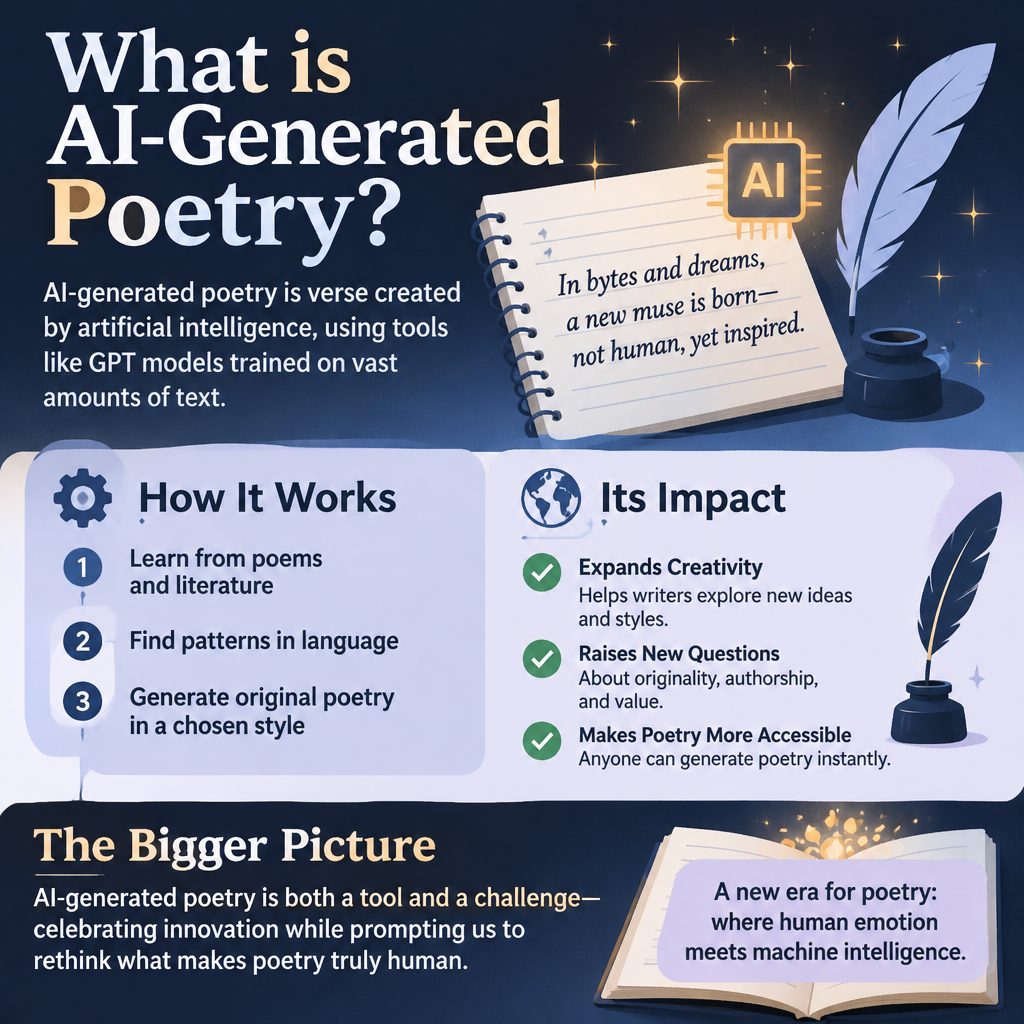
Many AI poetry tools use language models trained on broad collections of text. During training, these models learn patterns in language, including vocabulary, structure, and features associated with different kinds of writing.
When you enter a prompt—a theme, a form, or an opening line—the model generates text using those patterns and the context you provide. It can attempt a sonnet, haiku, free verse poem, or rhyming couplet, though it won’t necessarily follow every convention correctly.
The result isn’t a window into the system’s lived experience. It is generated language that a reader may find moving, unconvincing, amusing, or unexpectedly useful.
Which Terms Are Helpful to Know?
A few concepts make the process easier to understand:
- Language model: The system that generates text from learned patterns and the context supplied.
- Prompt: An instruction or starting point, such as “Write a haiku about summer rain.”
- Style imitation: An attempt to reproduce recognizable features of a poetic voice or tradition.
- Randomness settings: Controls available in some tools that influence how predictable the generated text is.
Increasing randomness can produce less expected wording, but surprise isn’t the same as quality. Sometimes you get an intriguing image; sometimes the metaphor needs directions home.
How Can You Try AI Poetry?
Start with a small experiment:
- Choose an approachable tool. A conversational writing tool allows discussion and revision; a dedicated generator may offer a simpler process.
- Give it a starting point. Choose a subject, emotion, image, or form.
- Explore available controls. Adjust length or tone if those options help.
- Read and revise. Keep useful passages, add your own lines, or ask for another approach.
- Save what interests you. Before publishing or submitting, check the relevant terms and requirements.
Trying different prompts can reveal what the tool handles well and where it struggles. I find brainstorming particularly useful: a suggested image or alternative phrase can interrupt a familiar writing habit without taking over the whole poem.
What Impact Can AI Have on the Writing Process?
The most immediate change is speed. Generating alternatives becomes easy, which gives a writer more material to consider.
That can help when a draft feels stuck. It can also create a new distraction: collecting versions instead of choosing words. I try to notice when another request would help and when I need to spend time with what is already on the page.
AI also changes the kinds of decisions a writer makes. Alongside composing lines, you may select, reject, rearrange, and respond to generated material. Those choices deserve attention. What did you keep, and why? What did the tool smooth away that you wanted to preserve?
Does AI Poetry Feel Authentic?
Authenticity becomes complicated when the words suggest an experience the system hasn’t lived.
Some readers place great importance on the person behind a poem. Others respond primarily to the language they encounter. A generated verse can still prompt a meaningful response without having feelings behind its production.
For my own writing, the question is whether the poem reflects what I mean. When the subject is deeply personal, I often return to my own observations and phrasing. A graceful line isn’t automatically the right line for that experience.
What About Originality and Credit?
Generated Doesn’t Guarantee Original
AI can produce new combinations of words, but it can also reproduce or closely resemble existing passages. Familiar phrases and clichés are only part of the concern.
I read for wording that sounds unusually familiar and reconsider anything that seems too close to a source. Personal editing helps shape the poem, but it doesn’t guarantee originality.
Explain the Contribution Clearly
If AI substantially contributed to a poem, I prefer to describe that process plainly. There’s a difference between requesting rhyming words, discussing revisions, and generating most of the draft.
Your choices matter, but changing a few lines doesn’t make an entirely human authorship claim accurate.
Check Before Submitting
A platform’s permission to use output, legal rights, and a publication’s submission rules are separate questions. Don’t assume that permission in one setting settles the others.
Read the relevant requirements before submitting or building a project around generated text. Editing and disclosure don’t automatically make a poem eligible everywhere.
How Can You Explore Beyond the First Draft?
A few approaches have made the process more interesting for me:
- Combine contributions: Write a stanza, consider an AI response, then continue in your own words.
- Try an unusual perspective: Instead of a broad subject, request something like “a poem about time told in the voice of the ocean.”
- Question the revisions: Ask why a change was suggested and decide whether the explanation makes sense.
- Read aloud: Listen for rhythm, forced rhymes, and language that sounds impressive but says little.
- Seek human feedback: Another reader can bring associations and questions the tool hasn’t considered.
Grammar and style suggestions can help, but poetry doesn’t always benefit from conventional correctness. Keep deliberate fragments, unusual syntax, or rough edges when they serve the work.
Where Can AI Poetry Be Used?
There are several ways to experiment with generated verse:
- Classroom exercises: Examine a prepared poem, check its form, and explain revisions.
- Literary experiments: Compare independent writing with work developed through AI suggestions.
- Visual or spoken pieces: Combine verse with images, projection, sound, or performance.
- Personal projects: Use a poem as a journaling prompt, a playful message, or material for further writing.
Each setting raises different questions. A classroom activity needs a clear learning purpose. A public performance may invite discussion about authorship. A personal exercise may simply give someone a reason to write that afternoon.
The impact depends on what people do with the material, rather than how quickly it was produced.
Frequently Asked Questions

Can AI-Generated Poetry Be Creative?
It can produce surprising language and combinations that readers experience as creative. Whether that makes the system itself creative depends on how the term is defined.
For my practice, the useful question is whether a suggestion helps me explore something I wouldn’t otherwise have considered.
Is AI Poetry Always Recognizable?
No reliable judgment follows from style alone. Repetition, unusual phrasing, or emotional language doesn’t prove how a poem was made.
A trained reader can assess the writing closely without necessarily knowing its origin. Clear information about the process is more useful than guessing.
Can I Publish an AI-Assisted Poem?
Check the particular publication’s current guidelines. Look for distinctions between generated text, brainstorming, and editing assistance, along with disclosure requirements.
If the rules are unclear, ask before submitting.
What Keeps Me Interested?
AI-generated poetry gives me another way to think about writing, inspiration, and choice. The result may become part of a poem, start an argument with my own ideas, or remind me to close the screen and write for myself.
I’m interested in that exchange: the unexpected phrase, the rejected suggestion, and the detail a person adds because it matters to them. The tool can produce words quickly. Deciding which ones deserve to stay is still worth taking time over.