The Tomato Woman
Nobody knew her name.
Which, oddly enough, is probably why people trusted her.
She appeared one afternoon without announcement, without branding, without a banner image explaining her philosophy of intentional living. There was no carefully engineered introduction thread. No “after many requests…” energy. No dramatic declaration about finally deciding to share her truth with the world.
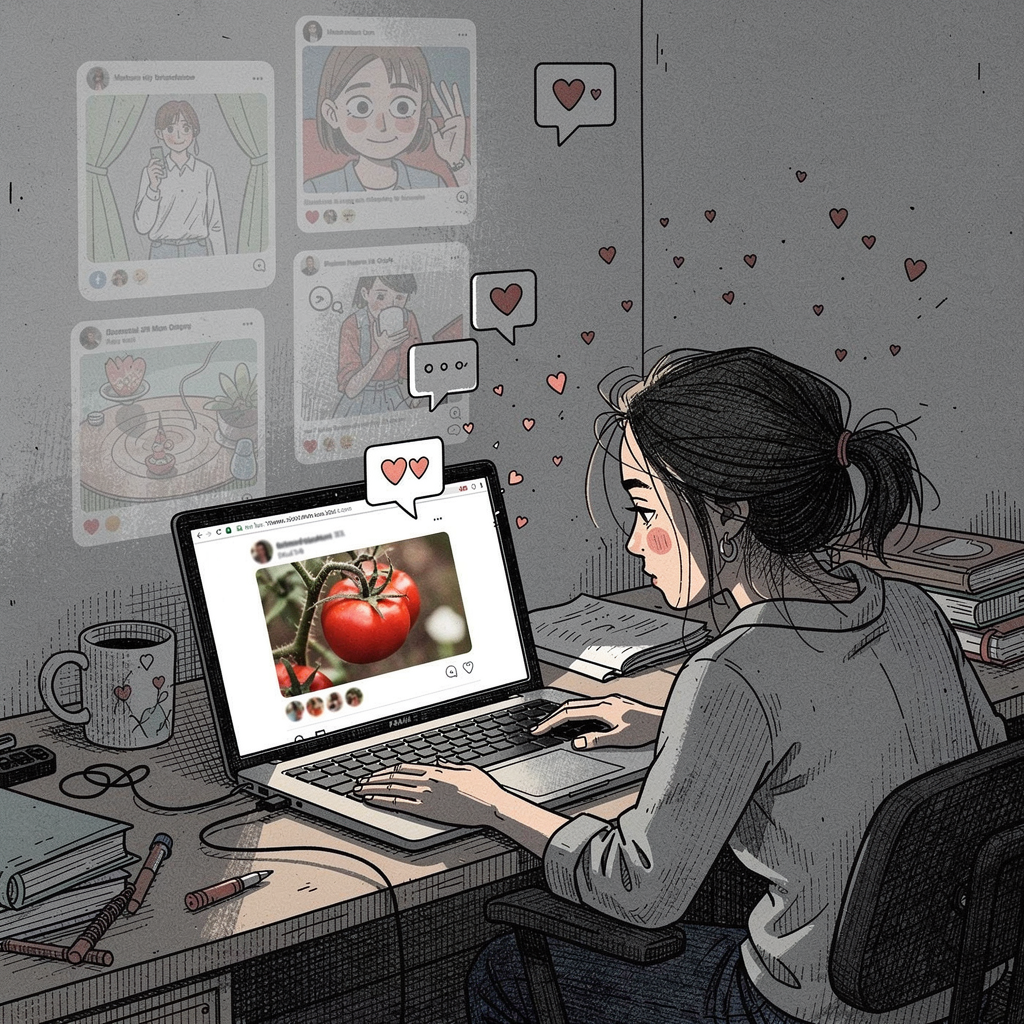
Just a photograph of tomatoes.
Slightly blurry.
Uneven lighting.
One tomato looked vaguely threatening for reasons nobody could explain.
The caption simply said:
“they finally grew 😌”
That was it.
No lessons.
No productivity metaphor.
No “what gardening taught me about leadership during uncertain times.”
Three likes.
One from her cousin.
Another from a woman named Denise whose entire account seemed dedicated to ceramic owls.
And for a moment the internet kept moving as usual around her. Loudly. Violently. Everyone optimizing themselves in public.
Elsewhere people were busy becoming brands.
A man with perfect lighting was explaining authenticity from inside what appeared to be an emotionally curated warehouse. Another person was crying in cinematic slow motion beneath subtitles that read:
“healing isn’t linear.”
Someone else was announcing they had quit social media for mental health reasons through a twelve-slide carousel sponsored by a wellness app.
The internet had become strange.
Not intentionally strange. More like accidentally overdeveloped. Like a city that slowly replaced all its small cafés with luxury banks pretending to look like cafés.
And somewhere in the middle of this, the Tomato Woman kept posting.
Tomatoes again.
A cucumber once.
Rain on a chair.
Half a burnt pie.
A photo so poorly framed that people debated whether her thumb was covering the lens or whether it was avant-garde.
Nobody understood why they kept stopping to look.
The posts contained none of the things modern internet culture had trained people to expect. No hooks. No urgency. No visible ambition clawing gently at the viewer’s nervous system.
She never asked anyone to “read that again.”
She never informed strangers that “most people aren’t ready for this conversation.”
Frankly, there barely seemed to be a conversation.
And yet people slowly gathered there anyway.
Quietly.
As though exhausted travelers had discovered a tiny roadside diner that still served actual food instead of deconstructed foam served on slate tiles by a man explaining the emotional journey of the appetizer.
Nobody knew why the Tomato Woman felt different.
But she did.
Perhaps because nothing in her posts appeared optimized for extraction. She was not converting her existence into a personal mythology. She was not translating ordinary life into content architecture.
The tomatoes were never symbols.
They were just tomatoes.
Which, by this point, had become almost shocking online.
One evening someone asked her in the comments:
“What’s your content strategy?”
Several minutes passed.
Then she replied:
“i just post things i like lol”
People stared at the sentence as though witnessing prehistoric language.
No framework.
No funnel.
Not even proper capitalization.
Some found it deeply moving.
Others found it suspicious.
A popular creator eventually made a twenty-minute video analyzing why her account felt “so authentic.” The video included soft piano music, psychological diagrams, and the phrase “digital intimacy ecosystem” repeated several times with alarming confidence.
Meanwhile the Tomato Woman uploaded a picture of soup.
The bowl was slightly out of focus.
The internet cried.
Not literally, of course.
But something inside people had grown tired. Tired of performance. Tired of optimization disguised as vulnerability. Tired of everyone sounding like motivational philosophers trapped inside marketing departments.
Perfection had become exhausting.
Everything looked polished now.
Everything sounded processed.
Even spontaneity arrived edited.
And so people began searching desperately for tiny signs of unmanufactured life.
A strange sentence.
An awkward silence.
A typo left alive.
Tomatoes.
The experts called this shift many things. Some blamed algorithms. Others blamed AI. Others blamed capitalism, branding culture, attention economics, dopamine loops, or “the collapse of shared symbolic coherence in post-digital identity systems,” which sounded serious enough that nobody questioned it.
But honestly?
People were probably just lonely.
And the Tomato Woman, without realizing it, had accidentally stopped performing long enough for others to remember what an actual person looked like.
Which, in the end, turned out to be far more radical than authenticity ever was.
The dreamweaver GPT
A poetic GPT that helps you unravel your dreams and reshape them into stories, metaphors, or messages from the deep self. Bring your fragments — it will weave the rest.