The Master
The little I know
Does not compare
To the much
I don’t know
Those lines read like a quiet bow to humility. The mark of a true learner. In just a few words, they echo an old philosophical truth: wisdom begins when we recognize the vastness of what we do not know.
Many thinkers have expressed this idea. Socrates famously said, “I know that I know nothing.” The poem stands in that same reflective light.
Here’s how the poem resonates:
- “The little I know” : a recognition of the knowledge we have gathered.
- “Does not compare” : the turning point, where perspective widens.
- “To the much I don’t know” : an acceptance that the unknown is far greater than the known.
It captures the spirit of a master not as someone who knows everything, but as someone who understands the endless horizon of learning.
The poem feels almost like a Zen koan… simple, quiet, and deep.
Inspired by this piece, a short companion poem:
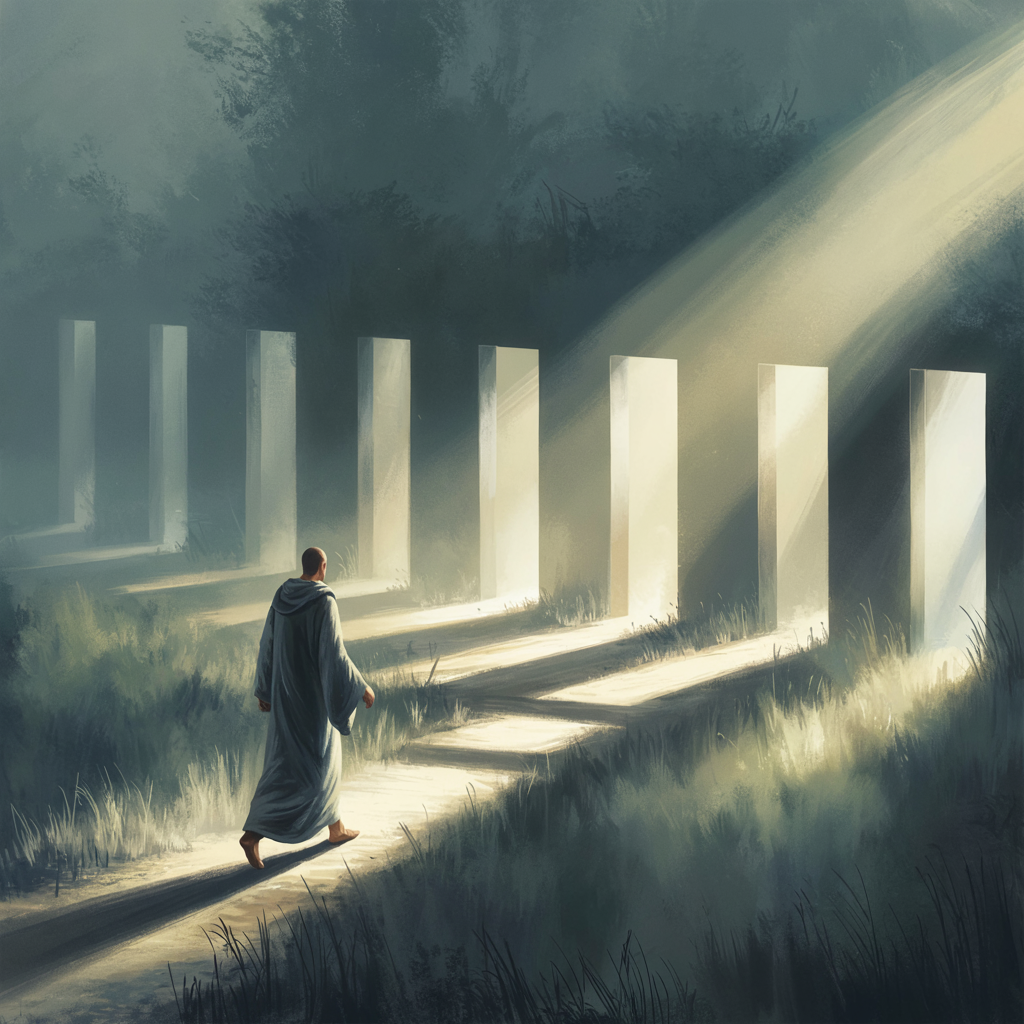
The master walks lightly,
carrying no crown of knowing.
Each answer he finds
opens ten silent doors.
For wisdom is not the mountain reached,
but the endless path
through mist and wonder.
“Where is the wisdom we have lost in knowledge?”
~ poet T.S. Eliot
What is a Zen Koan?
A Zen koan is a form of riddle or paradoxical statement that serves as a meditative device within Zen Buddhism. Designed to transcend conventional thinking, these enigmatic expressions challenge practitioners to dissolve the boundaries of logic and reasoning. The essence of a koan lies in its ability to evoke doubt and inquiry, prompting deeper contemplation rather than straightforward answers. By engaging with a koan, the Zen practitioner is encouraged to explore the nature of existence and consciousness.
Characteristics of Zen koans often include their striking paradoxes, which serve to provoke a shift in perception. For example, well-known koans such as “What is the sound of one hand clapping?” or “If you meet the Buddha on the road, kill him!” illustrate how they defy normal reasoning. The intention behind these koans is not to convey a logical solution but rather to immerse the student in a meditative exploration of the mind’s complexities. The paradoxical nature of these questions often leads practitioners into a state of heightened awareness and deeper understanding of their spiritual path.
Within the context of Zen practice, koans are used as tools for meditation, encouraging practitioners to focus their minds and delve into the core of their being. They challenge formally trained intellectual habits, incentivizing a more intuitive and direct experience of reality. This non-dual approach, which koans exemplify, allows practitioners to step beyond the confines of analytical thinking. In this light, Zen koans are not simply literary curiosities; they are vital links to understanding the nuances of Zen attitudes toward enlightenment and existence.
Historical Background of Zen Koans
Zen koans, which are paradoxical anecdotes or riddles used in Zen practice, have a rich historical background that traces their roots to ancient Buddhist teachings in China. The concept of koans primarily emerged during the Tang Dynasty (618–907 CE), a period marked by the flourishing of Chan Buddhism, which later became known as Zen in Japan. During this era, Chinese Zen masters began to employ koans as a means to assist students in transcending ordinary logic and reaching deeper states of enlightenment.
The Song Dynasty (960–1279 CE) further solidified the significance of koans within Zen training. It was during this period that the practice of using koans became more formalized, with teachers such as Linji Yixuan and Zhaozhou Congshen introducing specific cases and dialogues that became foundational to later teachings. These masters emphasized not just intellectual understanding of the koans but also experiential insight, encouraging practitioners to engage deeply with the material as a path to enlightenment.
Moreover, the historical significance of figures like Hakuin Ekaku in Japan, who revitalized the use of koans in the 18th century, cannot be overlooked. His approach sought to ensure that koans remained relevant within the context of modern Zen practice, thus fostering a deeper connection to the core principles of Buddhism. The integration of koans as a central element in Zen training emphasized the importance of personal experience over theoretical knowledge, encouraging practitioners to confront their own perceptions of reality.
In conclusion, the historical development of Zen koans reflects a profound evolution influenced by significant periods and figures in Buddhist history, ultimately shaping the unique aspects of Zen practice that continue to resonate today.
Famous Koans and Their Meanings
Zen koans serve as vital tools in the Zen tradition, prompting introspection and a deeper understanding of reality. One of the most renowned koans is, “What is the sound of one hand clapping?” This enigma challenges the practitioner to explore beyond dualistic thinking and conventional concepts of sound and silence. It encourages an examination of perception. It invites one to consider the essence of existence devoid of typical dichotomies, thus facilitating a direct experience with the nature of sound itself.
Another significant koan is the question posed by Huineng, the sixth patriarch of Zen: “The ordinary mind is the Way.” This statement invites meditators to recognize that enlightenment is not found in distant realms of abstraction but in the immediacy of one’s everyday experiences. It emphasizes that the path to wisdom and clarity can be accessed through an unembellished, direct engagement with daily life, promoting an appreciation for the present moment.
Additionally, the koan, “If you meet the Buddha on the road, kill him,” attributed to the Zen master Linji, challenges adherents to transcend their own preconceived notions of enlightenment, represented by the figure of the Buddha. This provocative injunction symbolizes a radical departure from attachments to concepts and forms of spirituality. It emphasizes the necessity of letting go of fixed beliefs and images to experience a truer understanding of reality.
These examples of famous Zen koans illustrate their remarkable depth and the wisdom they embody. They embody the essence of Zen practice: inviting contemplation, guiding through paradoxes, and ultimately leading to profound realizations. By engaging with these koans, practitioners embark on a transformative journey toward self-discovery and enlightenment.
Influential Poets and their Relationship to Zen Koans
Throughout literary history, Zen koans have profoundly influenced the works of various poets, allowing them to delve into complex themes of existence and consciousness. A notable figure in this realm is R.H. Blyth, a scholar and poet known for bringing Zen Buddhist philosophy to the English-speaking world. His extensive writings on Japanese poetry highlight the interconnection between Zen koans and natural imagery, capturing the essence of simplicity and spontaneity that characterizes Zen thought. Blyth’s interpretations often reflect a deep contemplation of life and the universe, using koans as catalysts for deeper understanding and creative expression.
Another significant poet who embraced Zen influences is Gary Snyder. His poetry is heavily imbued with nature and Eastern philosophy, reflecting his immersion in Zen practices. In works such as Mountain Home and The Poetry of Zen, Snyder employs the structure and form of Zen koans to convey moments of enlightenment and introspection. His unique ability to blend Western poetic styles with Eastern philosophical ideas enables readers to experience the subtlety of Zen teachings through vivid imagery and evocative language.
Bill Porter, known by his pen name Red Pine, is another influential figure in this context. As a translator of ancient Chinese texts and a poet, he has provided access to a wider audience regarding the philosophical profundity of Zen koans. In his works, Porter reflects on the nature of consciousness and the esoteric qualities of existence, often using koans as a means of framing his contemplative observations. His blending of poetry and Zen philosophy invites readers to ponder the deeper meanings behind the seemingly nonsensical phrases, sparking personal insights and revelations.
These poets, among others, reveal how Zen koans serve not only as literary devices but also as pathways to understanding the intricacies of human existence and consciousness. Their contributions highlight the richness of Zen’s influence on contemporary poetry, showcasing the tradition’s enduring relevance in exploring timeless questions and themes.
Thank you for shares and comments! 😀🎉
image Picsart and MIB